19 moves
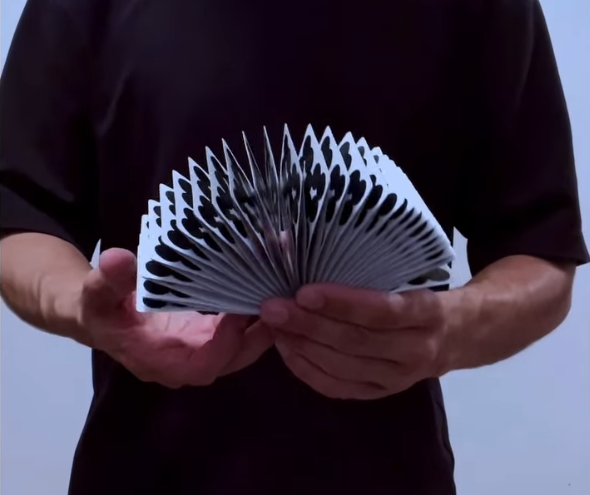
The Click Fan is a fan that uses the opposing bends of each card to spread into a bloom-esque display, and then bending the cards lengthwise to make each card shift slightly to the left, making the face of each card visible

Packet Muscle Pass is a striking aerial cardistry move where a 10-15 card packet is shot horizontally between hands using pure built-up tension. By heavily bending the cards and instantly releasing the pinky finger, the packet dynamically flips 180 degrees mid-air with minimal hand movement.

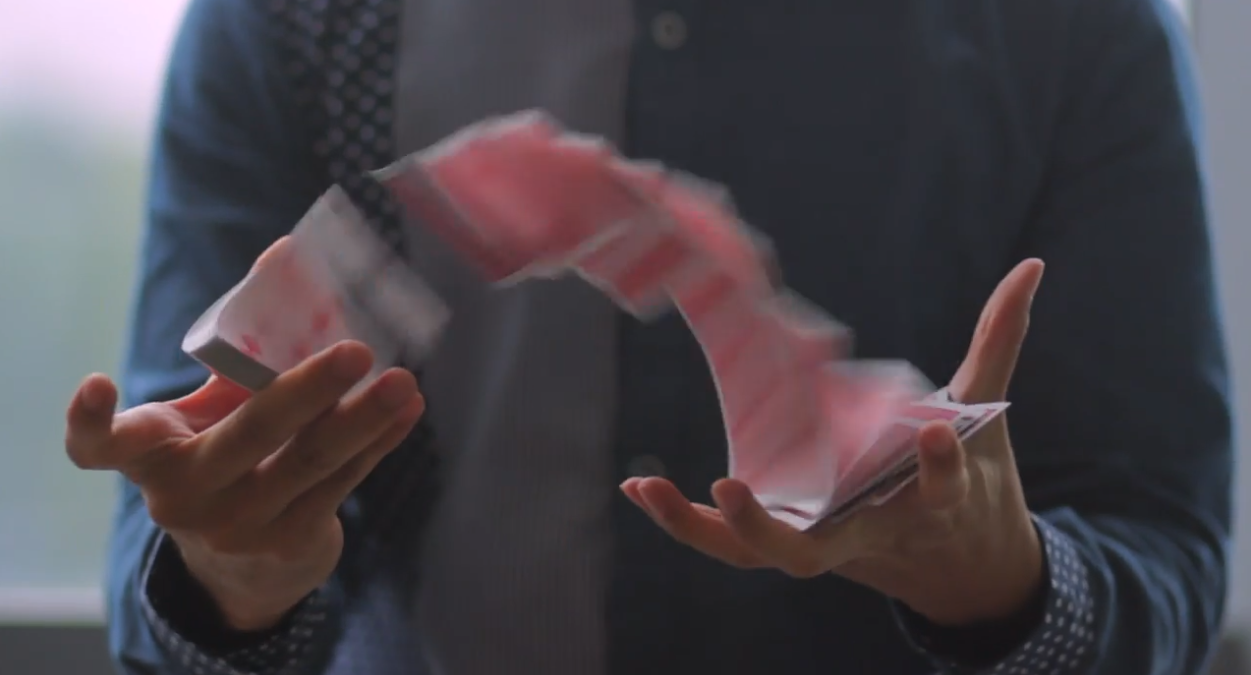
Rainbow Spring is a variation of the Spring, which springs cards in a rainbow-like arc. The move was first officially presented in his YouTube video THROUGH SILK (WKC 2013/2014).

Vad Fan is a fan which creates two fans simultaneously with the cards sliding on the thumb and middle finger of the opposite hand. Mechanics To prepare for the Vad Fan, the cards are interlaced using a Faro Shuffle and the packets are arranged in an inverted "V" shape, similarly to a Cascade. The packets are typically held at an angle between 90 and 180 degrees. For people with smaller hands, it is also acceptable to reduce the angle slightly below 90 degrees or slide the cards slightly inward. The little finger is then placed on the short edge, while the ring finger and thumb grip the outermost corners. The middle and index fingers may rest along the long edge. The cards are gradually compressed while being supported by the thumbnail and the index or middle fingernail of the opposite hand in the lower central area of the cards. The pressure is then slowly released, forming two fans at the same time. No established ending for the move has been developed yet. History Karlsson first published the move in a cardists' meetup video titled Cha-cha-cha on his YouTube channel. He officially presented the move at the second Cardistry-Con on April 10, 2015.

Side Pressure Fan is a rare pressure-based alternative to the Thumb Fan. The cards are spread by applying pressure to their short edges, using a technique inspired by the LePaul Spread.

Prestige Isolation is a simple isolation flourish that combines a fan with a single isolated card. The move traditionally begins with a fan created using the Side Pressure Fan technique, although a similar final effect can also be achieved with other fans, such as the Thumb Fan. A single card is then extracted from the fan and rotated in the style of the Rotation Isolation. The creator named the move after The Prestige (2006), drawing inspiration from the film's theme of magic.

Hot Shot is a aerial card shot that makes the card glide in the air by the action of the middle and pointer finger flicking it from the dack.

Super Fan is a fan in which interlaced cards slowly expand into a circular display under tension. Mechanics The cards are positioned similarly to a Cascade, forming a "V" shape. The interlaced section is supported with the other hand, while the thumb and middle finger grip the outer ends and bring them together. When the hand is moved away, the stored pressure causes the cards to rotate around pivot point, creating the characteristic fan. Variations So far, only one variation is known: A fully one-handed version, including the interlacing and tensioning of the cards. References Nanh Kiem, https://www.instagram.com/p/BVXNG82gt4n/

Anti-Faro is known as one of the hardest moves in cardistry, the move perfectly interlaces the cards, just like a Faro Shuffle would, but using Spring. The technique springs the cards onto an open palm, where they slide across one another and spread apart. The cards are then gently slid toward the center, allowing for a more precise grip. Anti Faro was originally created as a slight of hand move to be used in a magic routine, but changed over time to being able to perfectly and mathematically interlace the cards one by one.

Under Pressure is a fan flourish in which the cards flow smoothly from one hand to the other, creating a graceful wave-like motion. The cards are spread in the same way as in a Pressure Fan. However, once the fan reaches an angle of approximately 45–90 degrees, the deck is no longer rotated. Instead, pressure is continuously applied while the cards are gradually released from the fingers at the corner, allowing them to flow smoothly into the non-dominant hand, which gathers the returning cards.

Mockingod is a move in the cardistry community that is known as being difficult and taking a long period of time to fully master. Mockingod combines the moves Bobo III in the lower hand with two cards spinning in the upper hand. When done smoothly at high speeds, the cards look as if it is spinning rapidly.
