18 moves

Table Spread Shuffle is a shuffling technique performed by spreading the cards across a flat surface. The cards are first spread out, then the outer corner of the leading cards is lifted to bring them upright. This motion pulls the remaining cards along, creating a self-standing structure of cards. The hands are released from the final cards, allowing them to fall gradually and smoothly, creating a domino-like effect. The move is often finished with a Cascade using the collected, still-interlaced cards.

Anti-Faro is known as one of the hardest moves in cardistry, the move perfectly interlaces the cards, just like a Faro Shuffle would, but using Spring. The technique springs the cards onto an open palm, where they slide across one another and spread apart. The cards are then gently slid toward the center, allowing for a more precise grip. Anti Faro was originally created as a slight of hand move to be used in a magic routine, but changed over time to being able to perfectly and mathematically interlace the cards one by one.

One-Handed Table Shuffle is a technique that combines elements of both riffle and faro shuffling. Two aligned halves of the deck are placed close together at an angle. The index finger is then positioned at the point where the corners meet, lifting the packets upward while the remaining fingers press them together from the sides, allowing the cards to interlace.

Butt Shuffle is a variation of the Table Faro Shuffle that is performed in reverse. It's a version, where the bottom of the cards touches the surface and the interlacing occurs from bottom to top. Its main purpose is to imitate a Table Riffle Shuffle, creating the optical illusion of a standard table riffle, while in reality the cards interlace one-to-one.
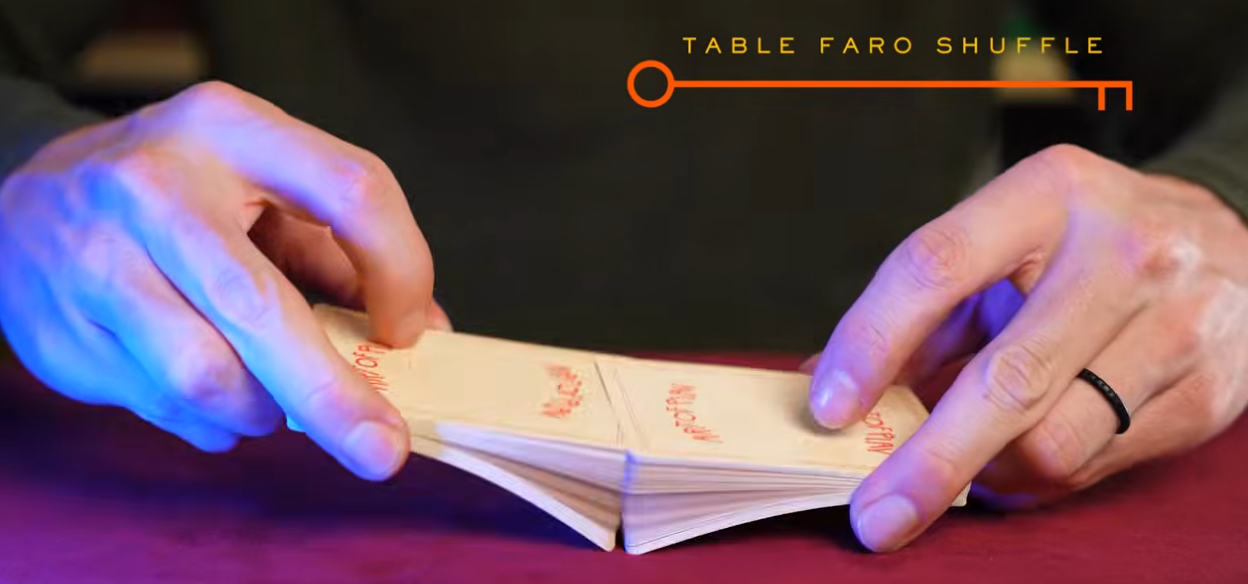
Table Faro Shuffle is a variation of the Faro Shuffle that perfectly interlaces cards on a flat surface. The technique is performed from top to bottom and only the edge of the cards touches the table

Table Riffle Shuffle is a professional, efficient card shuffling technique widely used in magic, casinos, and competitive card games. It is performed on a table surface by riffling the long edges of the cards. Unlike the standard Riffle Shuffle, this method is less prone to exposing cards to players, making the shuffle more discreet.

Hindu Shuffle is a simple shuffle originating from Asia and is commonly used in many Eastern regions. It begins by taking a substantial portion of cards from the bottom of the deck with the dominant hand, then stripping off small packets into the other hand. Its mechanics are similar to the Strip Cut, with the key difference that it is performed entirely in the hands, without using a table or other surface.
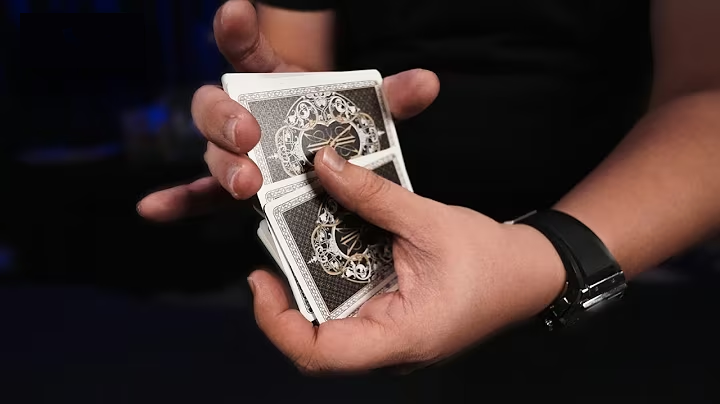
Overhand Shuffle is one of the easiest and most common ways to shuffle a pack of cards. It's a great shuffle for magicians to use since lay people are already familiar with it, and because there are some great controls and false shuffles that can be done while shuffling the deck in this manner. The shuffle is commonly used in western countries. References The description above is adapted from the 52Kards video, https://www.youtube.com/watch?v=A0J_487VquE

Strip Cut, also known among dealers as the Box Cut, is a professional table shuffle used as an official part of the shuffling procedure in competitive card games such as poker tournaments. The move begins by lifting a substantial portion of the deck with the non-dominant hand, then systematically stripping off small packets onto a pile on the table.
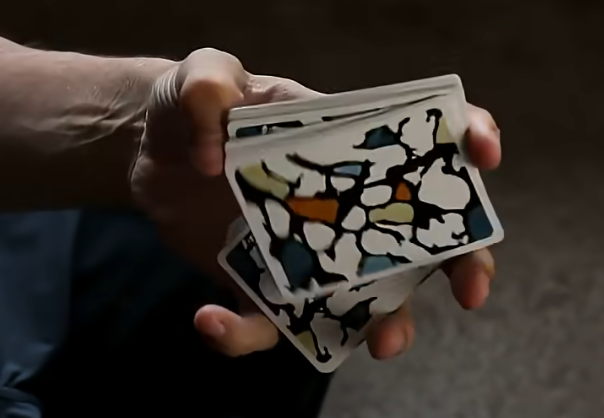
Running Scissor Cut, also known as a One-Handed Overhand Shuffle, is a continuation of the Scissor Cut that systematically strips off smaller packets from the main bottom packet. References Dan & Dave discussing this move (5:06-7:54) https://www.youtube.com/watch?v=6m0mjWI7m1Y