43 moves

Table Riffle Shuffle is a professional, efficient card shuffling technique widely used in magic, casinos, and competitive card games. It is performed on a table surface by riffling the long edges of the cards. Unlike the standard Riffle Shuffle, this method is less prone to exposing cards to players, making the shuffle more discreet.
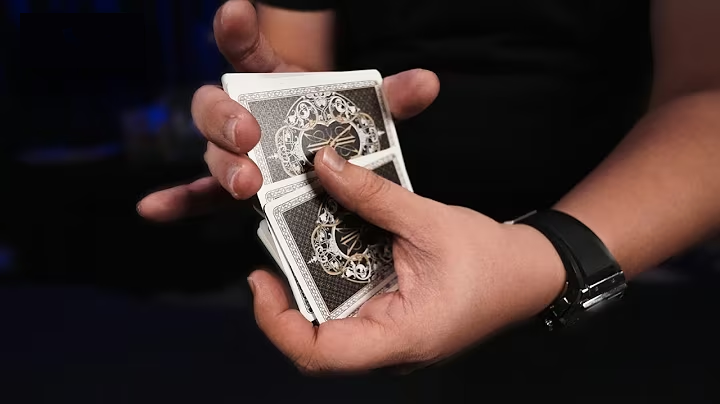
Overhand Shuffle is one of the easiest and most common ways to shuffle a pack of cards. It's a great shuffle for magicians to use since lay people are already familiar with it, and because there are some great controls and false shuffles that can be done while shuffling the deck in this manner. The shuffle is commonly used in western countries. References The description above is adapted from the 52Kards video, https://www.youtube.com/watch?v=A0J_487VquE

Charlier Triangle, also known as the Triple Charlier or Delta (not to be confused with the two handed false cut Delta), consists of creating a triangle in one hand. This can be done with the other hand at the same time to create a visually interesting pattern.
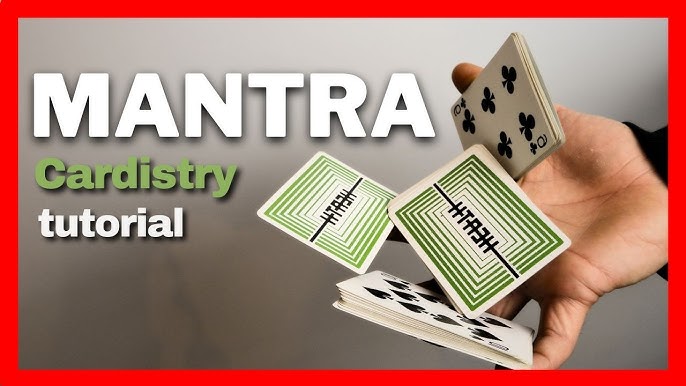
Mantra is one of the greatest one handed cardistry of all time. The move itself involves cutting a deck into two halves, then holding the lower packet in the lower part of your hand. The upper packet is then split into two using your thumb, simultaneously dragging out a single card out and then later combining the middle and lower packet together, flaring out the single card.

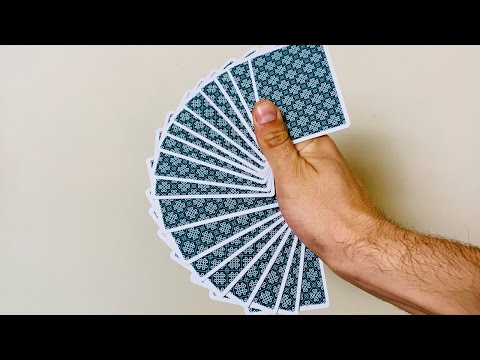
A beautiful one-handed fan. Can also be done with both hands.

Giant Fan is a variation of the thumb fan that uses interlaced cards to create a larger fan. A popular variation is to significantly rotate the top packet inward before performing the fan. References the variation's presentation, Youtube Short, https://youtube.com/shorts/B1mbZbHqwfM?si=1lJ4b5ddkx8qawmu

Cascade is one of the classic card drops. Interlaced cards are released freely, creating a waterfall-like effect, known as a cascade.

Prism is a modern classic flourish that involves constructing a complex card structure and rotating it around its own axis. The move is highly versatile, allowing for a wide variety of performances. Currently, the record for the highest number of layers constructed is 12, held by Hans Lankamp. Mechanics There are two ways to prepare the structure for spinning: no-cut method – the easiest and least demanding approach. Cards are drawn into the hand to form a triangle, after which packets are placed on the top and bottom. This method is especially useful for larger Prisms. cut method – separate the top packet and position it between the index and middle fingers (for example, using a Revolution Cut). Next, separate a larger group of cards from the thumb packet using the middle and little fingers. Then slide the ring finger beneath the newly formed packet to take another group of cards from the thumb packet. Finally, take a small group of cards from the outermost packet and place it beneath the structure to complete the base. At this stage, the structure should be stable enough to support itself on your hand or another flat surface. Once you are confident that the structure is stable, place the thumbnail at the center of the bottom packet and the index fingernail of the opposite hand at the center of the top packet. To initiate the spin, use the ring finger of the first hand. The rotation is then maintained by making a smooth circular motion with the wrist or the entire arm. A slight offset from the center of the thumbnail or index fingernail may help maintain a smoother rotation. Once the rotation has stopped, the structure can be presented in the most display view. Remove the opposite hand, slide the thumb out of the structure while keeping it extended, and present the completed construction on an open palm. Variations Variations differ in the shape of the structure, the number of layered structures, or the ability to perform two independent Prisms simultaneously. The most common shape-related variations include: A rhombus. An M-shaped Prism (referred to by the creator as "prisM"). A tower made of permanently bent cards arranged in an alternating pattern (known as "Prismeme"). References Instagram, Hans doing the record-breaking Prism https://www.instagram.com/p/DXUgi-5DKZk/ (0:41 to the end) https://www.reddit.com/r/cardistry/comments/1cojhrk/a_few_fun_prism_variations/ (0:17 to 0:31) https://www.reddit.com/r/cardistry/comments/1cojhrk/a_few_fun_prism_variations/ Instagram story on Andrew's official account (fourth slide): https://www.instagram.com/stories/highlights/17943856048346310/ Andrew's Instagram story (second slide): https://www.instagram.com/stories/highlights/17943856048346310/

LePaul Spread is a card spreading technique performed entirely in the hands. It is created by springing the cards and arranging them into: a straight line a semicircle an "S" shape Since the flourish relies on pressure rather than the condition of the deck, it can be performed even with worn cards without losing its visual appeal. However, practicing with inexpensive or less valuable decks is recommended, as the technique carries a significant risk of permanent damage to the cards along their width.

