89 moves

Prism is a modern classic flourish that involves constructing a complex card structure and rotating it around its own axis. The move is highly versatile, allowing for a wide variety of performances. Currently, the record for the highest number of layers constructed is 12, held by Hans Lankamp. Mechanics There are two ways to prepare the structure for spinning: no-cut method – the easiest and least demanding approach. Cards are drawn into the hand to form a triangle, after which packets are placed on the top and bottom. This method is especially useful for larger Prisms. cut method – separate the top packet and position it between the index and middle fingers (for example, using a Revolution Cut). Next, separate a larger group of cards from the thumb packet using the middle and little fingers. Then slide the ring finger beneath the newly formed packet to take another group of cards from the thumb packet. Finally, take a small group of cards from the outermost packet and place it beneath the structure to complete the base. At this stage, the structure should be stable enough to support itself on your hand or another flat surface. Once you are confident that the structure is stable, place the thumbnail at the center of the bottom packet and the index fingernail of the opposite hand at the center of the top packet. To initiate the spin, use the ring finger of the first hand. The rotation is then maintained by making a smooth circular motion with the wrist or the entire arm. A slight offset from the center of the thumbnail or index fingernail may help maintain a smoother rotation. Once the rotation has stopped, the structure can be presented in the most display view. Remove the opposite hand, slide the thumb out of the structure while keeping it extended, and present the completed construction on an open palm. Variations Variations differ in the shape of the structure, the number of layered structures, or the ability to perform two independent Prisms simultaneously. The most common shape-related variations include: A rhombus. An M-shaped Prism (referred to by the creator as "prisM"). A tower made of permanently bent cards arranged in an alternating pattern (known as "Prismeme"). References Instagram, Hans doing the record-breaking Prism https://www.instagram.com/p/DXUgi-5DKZk/ (0:41 to the end) https://www.reddit.com/r/cardistry/comments/1cojhrk/a_few_fun_prism_variations/ (0:17 to 0:31) https://www.reddit.com/r/cardistry/comments/1cojhrk/a_few_fun_prism_variations/ Instagram story on Andrew's official account (fourth slide): https://www.instagram.com/stories/highlights/17943856048346310/ Andrew's Instagram story (second slide): https://www.instagram.com/stories/highlights/17943856048346310/

Kabuto is an easy scissor cut variation that you'll be able to pick up in 5 minutes.
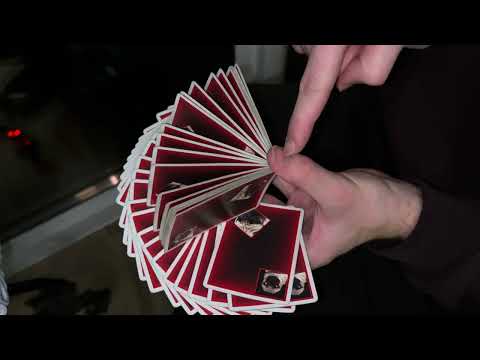
The Cake Fan is a three-dimensional fan that spreads the cards both vertically and horizontally in the hands, creating a shape reminiscent of a slice of cake.

Although this is one of Tobias' oldest flourishes, it's also one of his most popular and requested. Phaced is a variation of Joey Burton's Skater Cut. In this tutorial you will hear how this move was created and get an in-depth walkthrough of the mechanics.
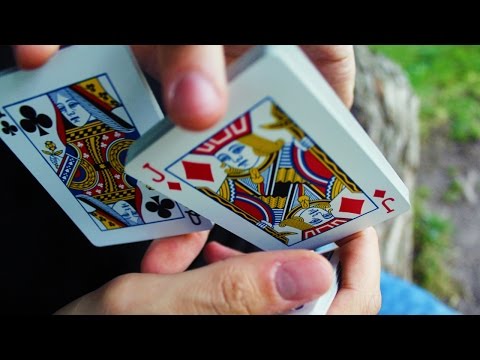
Transfix is one of Oliver's most classic flourishes. It's a combination of two simple three-packet cuts, each of which can be performed on their own. A packet rotates out of the deck to create an arrow-formation before closing with a seemingly chaotic movement of packets. A special four-packet version by Tobias is also explained in the tutorial.

Canvas by Nikolaj Pedersen is a clean three-packet cut with new and very distinct mechanics. Attention to simplicity and movement leaves you - the performer - more room for interpretation than usual. It is a fresh canvas waiting for you to paint with your personal brush.

Based on a move by Dan Buck called Swirly,
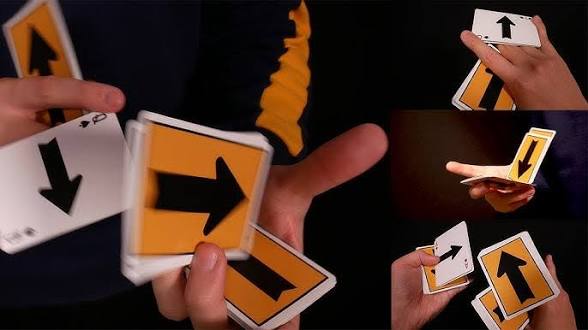
First appearing in Liquid Paper in 2016, Snake Charmer was inspired by the opener of Kevin’s cut Satellite, Dan and Dave’s Molecule 3, and the closer of Tobias Levin’s Acridid. The right-hand cut is called Sputnik, a reference to the world’s first artificial satellite.

Riffle Fan is created by evenly spreading the cards into a circular fan while riffling them. The entire fan is balanced on the tip of the index fingernail or thumbnail, allowing the cards to slide and rotate around a central pivot. The main challenge is finding the right balance between gravity and support. Applying too much upward pressure prevents the cards from sliding smoothly, while too little causes the fan to collapse.
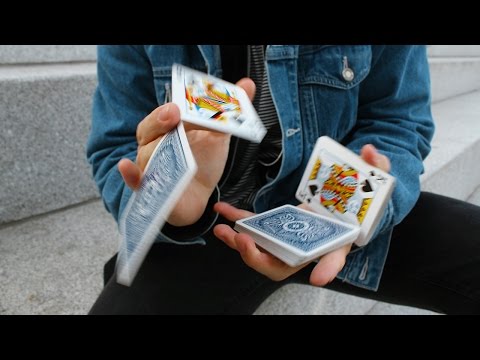
In order to understand and appreciate the art of cardistry combos, one must gather knowledge of as many moves as possible. Simplicity and practicality plays an important role when you're combining and/or improvising. Through the years, we've come across many different utility moves with different appearance and levels of simplicity. One we always come back to is Legolove by Nikolaj Pedersen. It is based off the classic Molecule rotation using the corners, and was first taught in the "Dynamite" tutorial series from 2011. It has become a part of our cardistry subconscious, and is a must-learn for every modern cardist. Sit back, grab a pack of cards, and learn Nikolaj's Legolove.


