162 moves
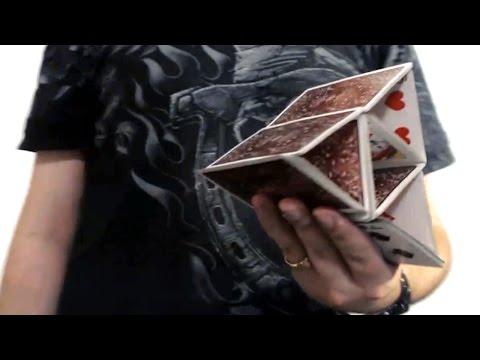
One Handed Triforce is widely regarded as one of the most difficult moves in cardistry. It is a highly complex structure built from three interconnected triangles forming a stable formation. The construction process involves carefully separating additional packets and gradually sliding them into place under controlled tension. Origin Antoine Thomas tells the story of the trick: I did play legend of zelda myself and forming a one-handed triforce is an idea that has been tickling that fractal-friendly mind of mine ever since I did my first square struct. The complex nature of that particular structure obviously wouldn't allow me to do a quick and flashy formation, yet I wanted something pleasing to watch... The solution was to make the formation itself a crazy recasting sequence, made of structures like the pentagon, the square in pentagon, the house, and the triple triad, leading to that dream-come-true climax. References quote from the description of video from XCM Vlog by Antoine on YouTube, https://www.youtube.com/watch?v=7BmP9GS8vdo&list=PLB6795B5456D9D846

Kryptonite is a complex one-handed flourish that divides the deck into multiple packets. Its difficulty and visual appeal come from rotating one packet while maintaining a demanding grip on the remaining packets, keeping them separate throughout the move.

Prism is a modern classic flourish that involves constructing a complex card structure and rotating it around its own axis. The move is highly versatile, allowing for a wide variety of performances. Currently, the record for the highest number of layers constructed is 12, held by Hans Lankamp. Mechanics There are two ways to prepare the structure for spinning: no-cut method – the easiest and least demanding approach. Cards are drawn into the hand to form a triangle, after which packets are placed on the top and bottom. This method is especially useful for larger Prisms. cut method – separate the top packet and position it between the index and middle fingers (for example, using a Revolution Cut). Next, separate a larger group of cards from the thumb packet using the middle and little fingers. Then slide the ring finger beneath the newly formed packet to take another group of cards from the thumb packet. Finally, take a small group of cards from the outermost packet and place it beneath the structure to complete the base. At this stage, the structure should be stable enough to support itself on your hand or another flat surface. Once you are confident that the structure is stable, place the thumbnail at the center of the bottom packet and the index fingernail of the opposite hand at the center of the top packet. To initiate the spin, use the ring finger of the first hand. The rotation is then maintained by making a smooth circular motion with the wrist or the entire arm. A slight offset from the center of the thumbnail or index fingernail may help maintain a smoother rotation. Once the rotation has stopped, the structure can be presented in the most display view. Remove the opposite hand, slide the thumb out of the structure while keeping it extended, and present the completed construction on an open palm. Variations Variations differ in the shape of the structure, the number of layered structures, or the ability to perform two independent Prisms simultaneously. The most common shape-related variations include: A rhombus. An M-shaped Prism (referred to by the creator as "prisM"). A tower made of permanently bent cards arranged in an alternating pattern (known as "Prismeme"). References Instagram, Hans doing the record-breaking Prism https://www.instagram.com/p/DXUgi-5DKZk/ (0:41 to the end) https://www.reddit.com/r/cardistry/comments/1cojhrk/a_few_fun_prism_variations/ (0:17 to 0:31) https://www.reddit.com/r/cardistry/comments/1cojhrk/a_few_fun_prism_variations/ Instagram story on Andrew's official account (fourth slide): https://www.instagram.com/stories/highlights/17943856048346310/ Andrew's Instagram story (second slide): https://www.instagram.com/stories/highlights/17943856048346310/


Kabuto is an easy scissor cut variation that you'll be able to pick up in 5 minutes.
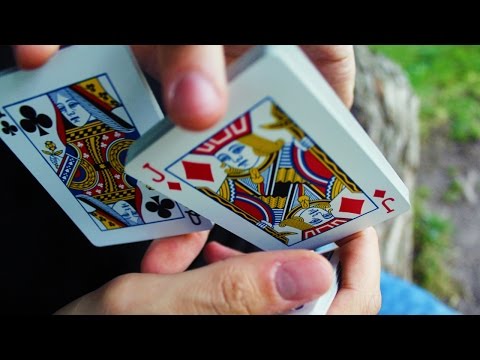
Transfix is one of Oliver's most classic flourishes. It's a combination of two simple three-packet cuts, each of which can be performed on their own. A packet rotates out of the deck to create an arrow-formation before closing with a seemingly chaotic movement of packets. A special four-packet version by Tobias is also explained in the tutorial.

Canvas by Nikolaj Pedersen is a clean three-packet cut with new and very distinct mechanics. Attention to simplicity and movement leaves you - the performer - more room for interpretation than usual. It is a fresh canvas waiting for you to paint with your personal brush.

Although this is one of Tobias' oldest flourishes, it's also one of his most popular and requested. Phaced is a variation of Joey Burton's Skater Cut. In this tutorial you will hear how this move was created and get an in-depth walkthrough of the mechanics.


The famous Sybil cut in cardistry was created by the magician and author Chris Kenner. It was first published in his 1992 book, Totally Out of Control, under the specific name the "Five Faces of Sybil".

