92 moves

Triforce, also known as Russian Pyramid , is a pyramid-shaped display made of three closely connected triangles. Two building methods are commonly used: Using the long edges of the cards. Using the short edges of the cards, resulting in a taller structure. References Ekaterina using this name in the film and in its title, https://www.youtube.com/watch?v=B27aJaIBfZk&t=17s sedimental channel, https://www.youtube.com/watch?v=4YsemigJrBs

Holy Grail, less commonly known as Azlan’s Cut, is a construction-based display featuring a diamond-shaped structure framed by packets at the top and bottom. It is built step by step by pushing successive groups of cards back into the deck, then completed with a single motion that "unlocks" the entire structure by spreading the fingers. The move was first presented at Cardistry-Con 2025 in New York. References this name was used in the description of the Cardistry Con 2025 premiere (move number 25) https://www.youtube.com/watch?v=bhjmmJpHpM8

Cadence is an intricate move composed of multiple packet cuts, displays, and unique flows. This move won Move of the year 2025, awarded by Cardistry Con.
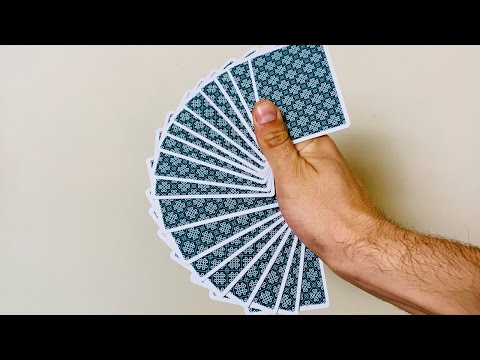
A beautiful one-handed fan. Can also be done with both hands.
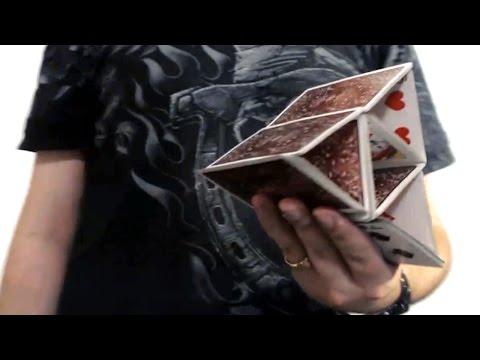
One Handed Triforce is widely regarded as one of the most difficult moves in cardistry. It is a highly complex structure built from three interconnected triangles forming a stable formation. The construction process involves carefully separating additional packets and gradually sliding them into place under controlled tension. Origin Antoine Thomas tells the story of the trick: I did play legend of zelda myself and forming a one-handed triforce is an idea that has been tickling that fractal-friendly mind of mine ever since I did my first square struct. The complex nature of that particular structure obviously wouldn't allow me to do a quick and flashy formation, yet I wanted something pleasing to watch... The solution was to make the formation itself a crazy recasting sequence, made of structures like the pentagon, the square in pentagon, the house, and the triple triad, leading to that dream-come-true climax. References quote from the description of video from XCM Vlog by Antoine on YouTube, https://www.youtube.com/watch?v=7BmP9GS8vdo&list=PLB6795B5456D9D846

Prism is a modern classic flourish that involves constructing a complex card structure and rotating it around its own axis. The move is highly versatile, allowing for a wide variety of performances. Currently, the record for the highest number of layers constructed is 12, held by Hans Lankamp. Mechanics There are two ways to prepare the structure for spinning: no-cut method – the easiest and least demanding approach. Cards are drawn into the hand to form a triangle, after which packets are placed on the top and bottom. This method is especially useful for larger Prisms. cut method – separate the top packet and position it between the index and middle fingers (for example, using a Revolution Cut). Next, separate a larger group of cards from the thumb packet using the middle and little fingers. Then slide the ring finger beneath the newly formed packet to take another group of cards from the thumb packet. Finally, take a small group of cards from the outermost packet and place it beneath the structure to complete the base. At this stage, the structure should be stable enough to support itself on your hand or another flat surface. Once you are confident that the structure is stable, place the thumbnail at the center of the bottom packet and the index fingernail of the opposite hand at the center of the top packet. To initiate the spin, use the ring finger of the first hand. The rotation is then maintained by making a smooth circular motion with the wrist or the entire arm. A slight offset from the center of the thumbnail or index fingernail may help maintain a smoother rotation. Once the rotation has stopped, the structure can be presented in the most display view. Remove the opposite hand, slide the thumb out of the structure while keeping it extended, and present the completed construction on an open palm. Variations Variations differ in the shape of the structure, the number of layered structures, or the ability to perform two independent Prisms simultaneously. The most common shape-related variations include: A rhombus. An M-shaped Prism (referred to by the creator as "prisM"). A tower made of permanently bent cards arranged in an alternating pattern (known as "Prismeme"). References Instagram, Hans doing the record-breaking Prism https://www.instagram.com/p/DXUgi-5DKZk/ (0:41 to the end) https://www.reddit.com/r/cardistry/comments/1cojhrk/a_few_fun_prism_variations/ (0:17 to 0:31) https://www.reddit.com/r/cardistry/comments/1cojhrk/a_few_fun_prism_variations/ Instagram story on Andrew's official account (fourth slide): https://www.instagram.com/stories/highlights/17943856048346310/ Andrew's Instagram story (second slide): https://www.instagram.com/stories/highlights/17943856048346310/
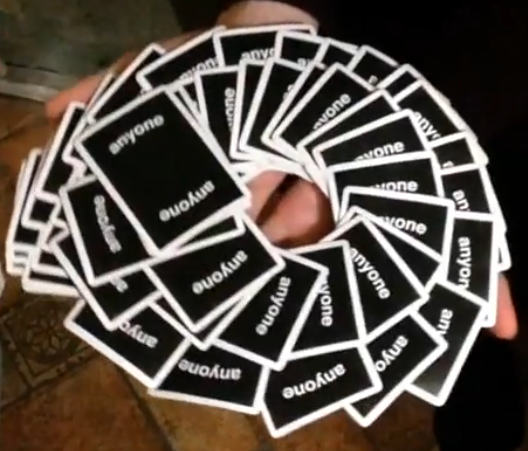
Donut Fan is a highly visual display flourish based on Thumb Fan. The fan is thrown into the air, allowing the falling cards to land on the hands and form a large donut-like shape. There are two main variations: A standard Thumb Fan transformed into a donut shape, where the cards are loosely spread apart. An interlaced Thumb Fan that is expanded into a larger donut, creating a much tighter and more structured formation.

Snap-dragon is a continuation for the One-Handed Shuffle that transforms the shuffled deck into a diamond-shaped structure. The deck is first pushed upward from underneath, causing the top cards to begin releasing from the interlace and form two packets resting against each other. Space is then created beneath the deck, allowing the cards to free themselves. The cards from the center are then slid inward toward each other, resulting in the characteristic rhombus shape. The name was created by the author because of the characteristic snapping sound made when forming the rhombus.


Based on a move by Dan Buck called Swirly,