
Harper is a furry

Kryptonite is a complex one-handed flourish that divides the deck into multiple packets. Its difficulty and visual appeal come from rotating one packet while maintaining a demanding grip on the remaining packets, keeping them separate throughout the move.

Prism is a modern classic flourish that involves constructing a complex card structure and rotating it around its own axis. The move is highly versatile, allowing for a wide variety of performances. Currently, the record for the highest number of layers constructed is 12, held by Hans Lankamp. Mechanics There are two ways to prepare the structure for spinning: no-cut method – the easiest and least demanding approach. Cards are drawn into the hand to form a triangle, after which packets are placed on the top and bottom. This method is especially useful for larger Prisms. cut method – separate the top packet and position it between the index and middle fingers (for example, using a Revolution Cut). Next, separate a larger group of cards from the thumb packet using the middle and little fingers. Then slide the ring finger beneath the newly formed packet to take another group of cards from the thumb packet. Finally, take a small group of cards from the outermost packet and place it beneath the structure to complete the base. At this stage, the structure should be stable enough to support itself on your hand or another flat surface. Once you are confident that the structure is stable, place the thumbnail at the center of the bottom packet and the index fingernail of the opposite hand at the center of the top packet. To initiate the spin, use the ring finger of the first hand. The rotation is then maintained by making a smooth circular motion with the wrist or the entire arm. A slight offset from the center of the thumbnail or index fingernail may help maintain a smoother rotation. Once the rotation has stopped, the structure can be presented in the most display view. Remove the opposite hand, slide the thumb out of the structure while keeping it extended, and present the completed construction on an open palm. Variations Variations differ in the shape of the structure, the number of layered structures, or the ability to perform two independent Prisms simultaneously. The most common shape-related variations include: A rhombus. An M-shaped Prism (referred to by the creator as "prisM"). A tower made of permanently bent cards arranged in an alternating pattern (known as "Prismeme"). References Instagram, Hans doing the record-breaking Prism https://www.instagram.com/p/DXUgi-5DKZk/ (0:41 to the end) https://www.reddit.com/r/cardistry/comments/1cojhrk/a_few_fun_prism_variations/ (0:17 to 0:31) https://www.reddit.com/r/cardistry/comments/1cojhrk/a_few_fun_prism_variations/ Instagram story on Andrew's official account (fourth slide): https://www.instagram.com/stories/highlights/17943856048346310/ Andrew's Instagram story (second slide): https://www.instagram.com/stories/highlights/17943856048346310/
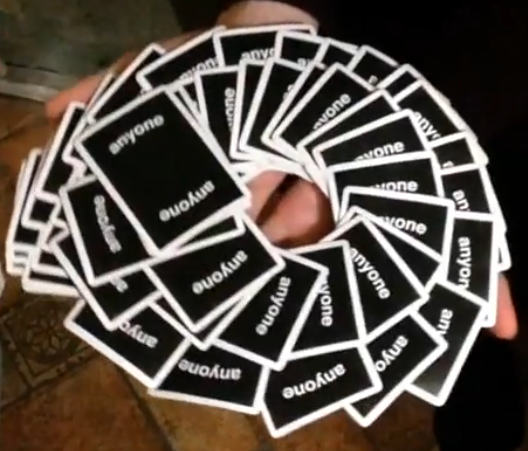
Donut Fan is a highly visual display flourish based on Thumb Fan. The fan is thrown into the air, allowing the falling cards to land on the hands and form a large donut-like shape. There are two main variations: A standard Thumb Fan transformed into a donut shape, where the cards are loosely spread apart. An interlaced Thumb Fan that is expanded into a larger donut, creating a much tighter and more structured formation.


Snap-dragon is a continuation for the One-Handed Shuffle that transforms the shuffled deck into a diamond-shaped structure. The deck is first pushed upward from underneath, causing the top cards to begin releasing from the interlace and form two packets resting against each other. Space is then created beneath the deck, allowing the cards to free themselves. The cards from the center are then slid inward toward each other, resulting in the characteristic rhombus shape. The name was created by the author because of the characteristic snapping sound made when forming the rhombus.
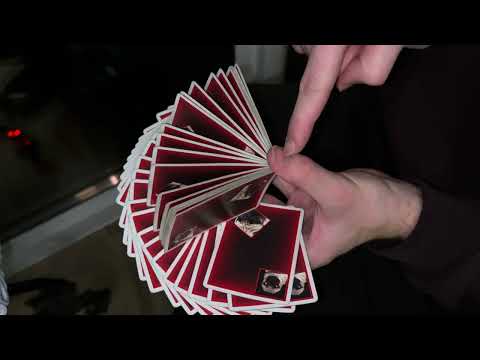
The Cake Fan is a three-dimensional fan that spreads the cards both vertically and horizontally in the hands, creating a shape reminiscent of a slice of cake.

The Tunnel Shuffle is an eye-catching shuffle based on a faro interlace, finished with a long bridge that resembles a tunnel-like structure. After the cards are interlaced, they are typically spread over the knee, then bent in a controlled way similar to a riffle bridge, creating a smooth, arched tunnel effect.

One-Handed Shuffle is a technique of shuffling cards using a faro-style interlace performed with a single hand. The ring finger or little finger is often used to stabilize the packets in the meeting corners.

Thin Spring is a variation of the Spring, in which cards are released from the right hand into the left hand (or vice versa), forming a clean straight line in the air. During the move, the cards remain parallel to the ground while traveling between the hands.

LePaul Spread is a card spreading technique performed entirely in the hands. It is created by springing the cards and arranging them into: a straight line a semicircle an "S" shape Since the flourish relies on pressure rather than the condition of the deck, it can be performed even with worn cards without losing its visual appeal. However, practicing with inexpensive or less valuable decks is recommended, as the technique carries a significant risk of permanent damage to the cards along their width.

