
Harper is a furry

Table Riffle Shuffle is a professional, efficient card shuffling technique widely used in magic, casinos, and competitive card games. It is performed on a table surface by riffling the long edges of the cards. Unlike the standard Riffle Shuffle, this method is less prone to exposing cards to players, making the shuffle more discreet.

Hindu Shuffle is a simple shuffle originating from Asia and is commonly used in many Eastern regions. It begins by taking a substantial portion of cards from the bottom of the deck with the dominant hand, then stripping off small packets into the other hand. Its mechanics are similar to the Strip Cut, with the key difference that it is performed entirely in the hands, without using a table or other surface.
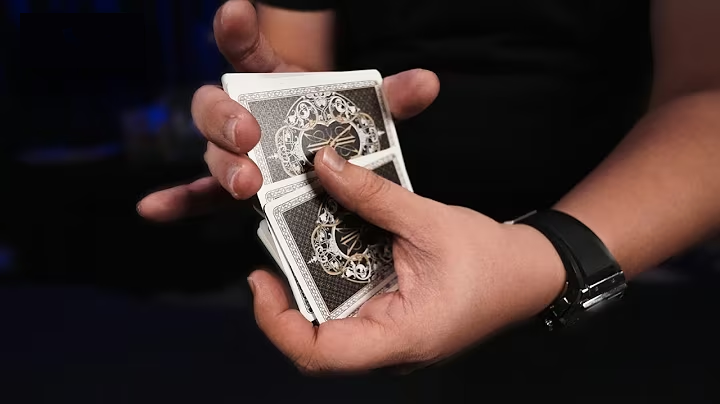
Overhand Shuffle is one of the easiest and most common ways to shuffle a pack of cards. It's a great shuffle for magicians to use since lay people are already familiar with it, and because there are some great controls and false shuffles that can be done while shuffling the deck in this manner. The shuffle is commonly used in western countries. References The description above is adapted from the 52Kards video, https://www.youtube.com/watch?v=A0J_487VquE

Strip Cut, also known among dealers as the Box Cut, is a professional table shuffle used as an official part of the shuffling procedure in competitive card games such as poker tournaments. The move begins by lifting a substantial portion of the deck with the non-dominant hand, then systematically stripping off small packets onto a pile on the table.

Triforce, also known as Russian Pyramid , is a pyramid-shaped display made of three closely connected triangles. Two building methods are commonly used: Using the long edges of the cards. Using the short edges of the cards, resulting in a taller structure. References Ekaterina using this name in the film and in its title, https://www.youtube.com/watch?v=B27aJaIBfZk&t=17s sedimental channel, https://www.youtube.com/watch?v=4YsemigJrBs

Holy Grail, less commonly known as Azlan’s Cut, is a construction-based display featuring a diamond-shaped structure framed by packets at the top and bottom. It is built step by step by pushing successive groups of cards back into the deck, then completed with a single motion that "unlocks" the entire structure by spreading the fingers. The move was first presented at Cardistry-Con 2025 in New York. References this name was used in the description of the Cardistry Con 2025 premiere (move number 25) https://www.youtube.com/watch?v=bhjmmJpHpM8
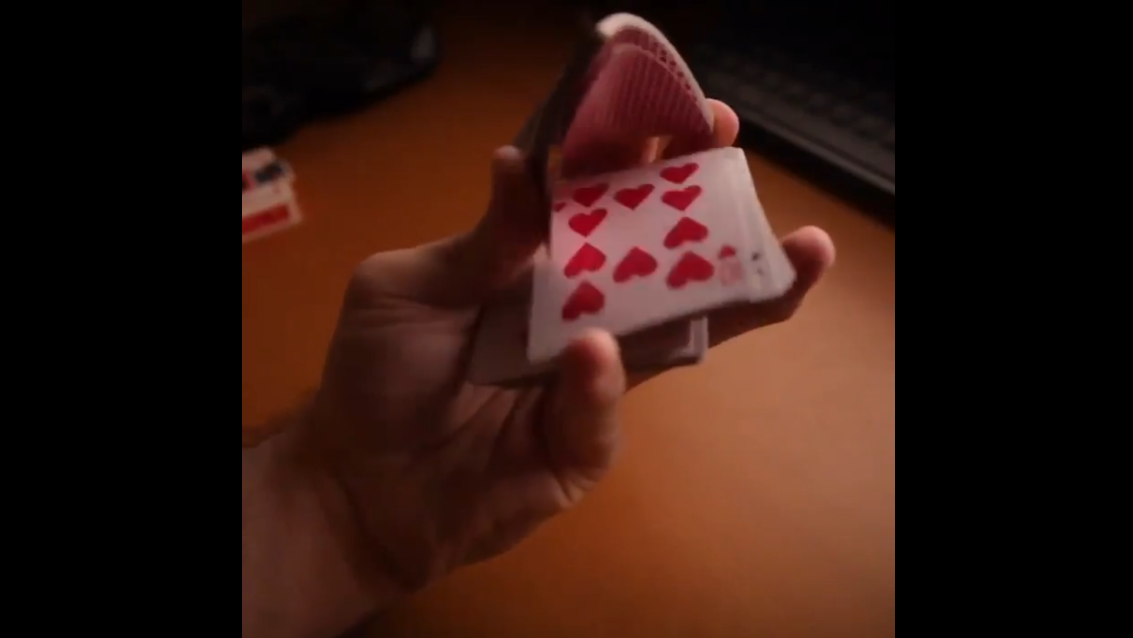
One-Handed Spring is a niche variation of the Spring. Its mechanics are similar to those of the traditional Spring, but the challenge lies in thumb placement. The thumb must be positioned precisely to allow the remaining cards to release smoothly, as they tend to catch against the fleshy pad of the thumb.
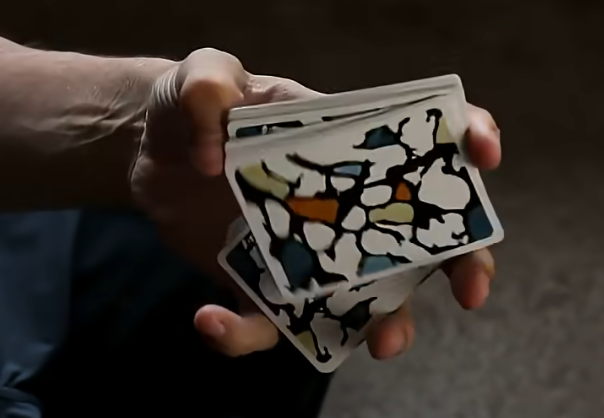
Running Scissor Cut, also known as a One-Handed Overhand Shuffle, is a continuation of the Scissor Cut that systematically strips off smaller packets from the main bottom packet. References Dan & Dave discussing this move (5:06-7:54) https://www.youtube.com/watch?v=6m0mjWI7m1Y

Waterbend is a smooth card drop in which the cards form two simultaneous arcs, creating the illusion of a flowing waterfall. Variations Two popular variations of the move are: The classic version, where the cards are arranged in a "T" shape. A variation where the upper packet is positioned noticeably higher. Origin I still remember the day Waterbend started to come together. I was just on my couch messing around with cards, I thought about how beautiful and iconic so many cascade moves are and how there aren't nearly as many of them as packet cuts. After a faro shuffle, I started experimenting with different grips to see what kinds of cascades I could create with the interwoven cards. At some point, I noticed the cards almost looked like they were falling and bouncing off my fingers, and I thought that was a really interesting idea to chase. After a ton of experimenting, I discovered that rotating half the deck sideways let the cards fall onto my thumb and align once landing in my other hand. From there, everything just clicked, and Waterbend was born. —Joe Feldpausch References Nikita Yatsik performing the variation: https://www.youtube.com/shorts/sq66-g-jd-I
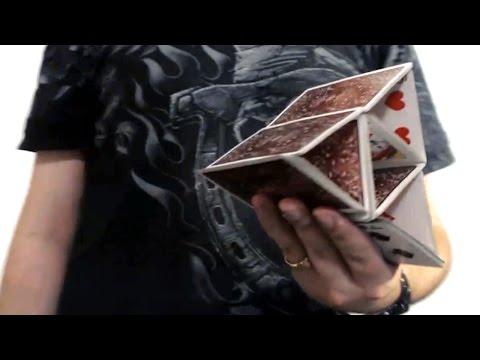
One Handed Triforce is widely regarded as one of the most difficult moves in cardistry. It is a highly complex structure built from three interconnected triangles forming a stable formation. The construction process involves carefully separating additional packets and gradually sliding them into place under controlled tension. Origin Antoine Thomas tells the story of the trick: I did play legend of zelda myself and forming a one-handed triforce is an idea that has been tickling that fractal-friendly mind of mine ever since I did my first square struct. The complex nature of that particular structure obviously wouldn't allow me to do a quick and flashy formation, yet I wanted something pleasing to watch... The solution was to make the formation itself a crazy recasting sequence, made of structures like the pentagon, the square in pentagon, the house, and the triple triad, leading to that dream-come-true climax. References quote from the description of video from XCM Vlog by Antoine on YouTube, https://www.youtube.com/watch?v=7BmP9GS8vdo&list=PLB6795B5456D9D846

Giant Fan is a variation of the thumb fan that uses interlaced cards to create a larger fan. A popular variation is to significantly rotate the top packet inward before performing the fan. References the variation's presentation, Youtube Short, https://youtube.com/shorts/B1mbZbHqwfM?si=1lJ4b5ddkx8qawmu

Cascade is one of the classic card drops. Interlaced cards are released freely, creating a waterfall-like effect, known as a cascade.
