


A cool way to flip a deck with style.

The Swing Cut is one of the best packet cuts to introduce to beginners in both cardistry and magic.
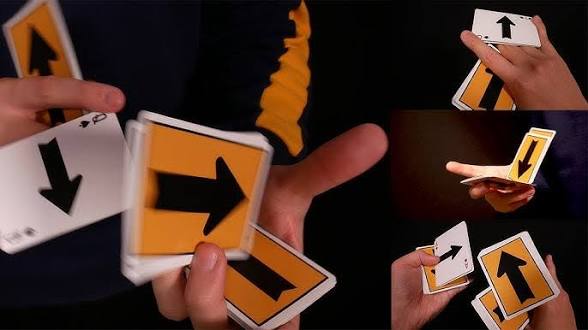
First appearing in Liquid Paper in 2016, Snake Charmer was inspired by the opener of Kevin’s cut Satellite, Dan and Dave’s Molecule 3, and the closer of Tobias Levin’s Acridid. The right-hand cut is called Sputnik, a reference to the world’s first artificial satellite.


Riffle Fan is created by evenly spreading the cards into a circular fan while riffling them. The entire fan is balanced on the tip of the index fingernail or thumbnail, allowing the cards to slide and rotate around a central pivot. The main challenge is finding the right balance between gravity and support. Applying too much upward pressure prevents the cards from sliding smoothly, while too little causes the fan to collapse.

One of the first single-card twirls to be done on the non-dominant hand.

One of the most iconic flourishes of all time. First released in The Triology in 2007.


Naoki Fan is an extension of the Smear Fan that reaches 360 degrees. A more difficult version is to make a fan with interlanced cards for greater results References Predator performing the variation on both hands (3:26-3:33) https://www.youtube.com/watch?v=KhQHnAiPdqg


